

Canada’s climate is one of the most variable on earth. A country that spans six time zones and multiple climate systems — coastal maritime, continental prairie, boreal, and arctic — produces weather conditions that affect vehicle transport in ways that shippers from more temperate countries rarely anticipate.
Snow, ice, extreme cold, coastal storms, and spring flooding all interact with carrier scheduling and transit times in ways that are worth understanding before you book a shipment.
None of this makes Canadian vehicle transport unreliable. Carriers operate year-round through conditions that would shut down transport networks in other countries.
What it means is that seasonal and regional weather factors are genuine variables in any Canadian shipment, and the shipper who accounts for them plans better than the one who ignores them.
Winter on the Prairies
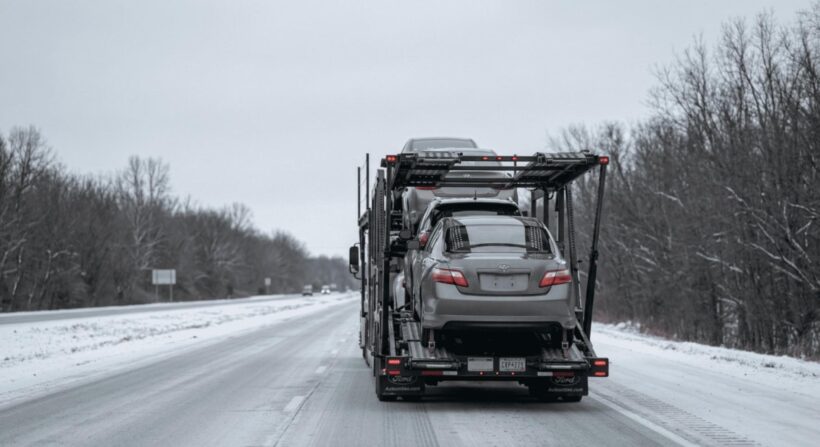
The Prairie provinces produce the most consistently severe winter conditions in the domestic carrier network. Temperatures in Saskatchewan and Manitoba routinely reach minus thirty, and blizzards that close the Trans-Canada for extended periods are a regular feature of January and February rather than exceptional events.
Carriers operating on Prairie routes in winter do not stop running. They adjust speeds, take alternate routing when closures require it, and build weather buffer into their scheduling.
What does not happen is that a blizzard-closed highway resolves itself on the shipper’s preferred timeline.
A road closure that adds eighteen hours to a transit is eighteen hours added to the delivery window, regardless of what the original estimate said.
For owners booking winter Prairie shipments — Toronto to Calgary, Winnipeg to Vancouver, or any corridor that crosses Saskatchewan or Manitoba between November and March — the practical adjustment is simple: use the upper end of the transit estimate as the planning baseline, not the lower end.
A corridor that runs seven to ten days in summer should be planned around ten to thirteen days in January. The gap is the weather buffer, and it is not pessimism — it is accurate scheduling.
Car shipping through Winnipeg in winter specifically carries this variability more than almost any other corridor in the country, given the city’s position at the centre of the Prairie weather system.
The Mountain Pass Dimension
The Coquihalla Highway, Rogers Pass, and the Kicking Horse corridor between Alberta and British Columbia represent the single most weather-sensitive segment of any major Canadian carrier route.
In summer, these passes are straightforward. In winter, they introduce genuine variability — chain requirements, speed restrictions, and full closures during major storm events — that affects every carrier moving between the Prairie provinces and BC.
The Coquihalla in particular is known for rapid weather changes. Conditions that are clear in Hope can be significantly worse at the summit, and carriers who know the route plan accordingly.
But planning for variability is not the same as eliminating it. A carrier moving a vehicle from Calgary to Vancouver in February cannot guarantee arrival on a specific day because the pass may impose a delay they cannot control.
Owners shipping on this corridor in winter should build three to four additional days into the transit estimate beyond what summer benchmarks suggest.
A summer Calgary-to-Vancouver transit of six to eight days becomes a more realistic eight to twelve days in December or January. Shippers who account for this arrive with their expectations intact.
Those who plan around the summer estimate often discover the difference in a less comfortable way.
Atlantic Coastal Storms and the Maritime Variable
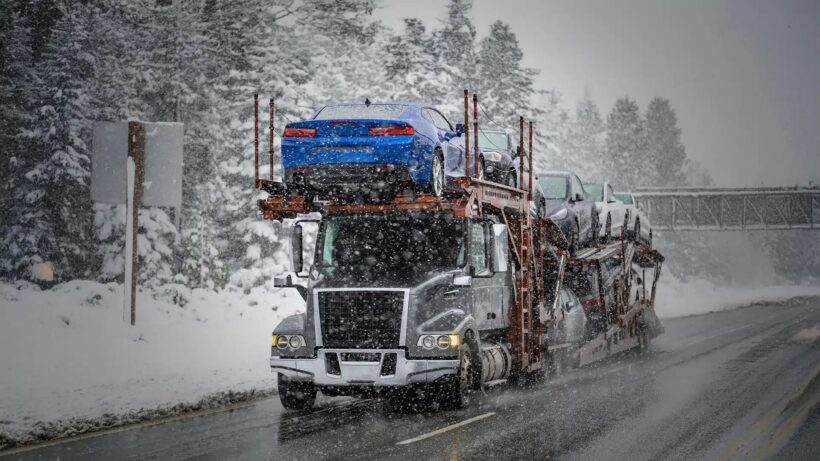
Atlantic Canada’s weather is shaped by its coastal geography in ways that differ fundamentally from Prairie or mountain weather.
Rather than extreme cold and blizzard conditions, the Maritime provinces experience significant precipitation events — nor’easters, freezing rain, and coastal storms that create ice and visibility conditions on highways that are distinct from the dry cold of inland winter.
The Trans-Canada through New Brunswick and Nova Scotia is a well-maintained highway, but freezing rain events in particular can affect carrier scheduling in ways that snow alone does not.
Freezing rain creates road surface conditions that require reduced speeds or temporary halts regardless of plowing and sanding operations.
A carrier moving from Montreal to Halifax in January may encounter one of these events on the New Brunswick segment, adding time to the journey without warning.
Ferry crossings in the region introduce an additional weather variable. Marine Atlantic service between Nova Scotia and Newfoundland is subject to cancellation in significant swells or storm conditions.
A vehicle destined for St. John’s that arrives at North Sydney during a weather-cancelled crossing waits for the next available departure — which may be a day or more away depending on the storm’s duration.
Newfoundland-bound winter shipments should be planned with this possibility explicitly accounted for rather than treated as an unlikely exception.
Car shipping through Halifax in winter involves both the highway weather variable and, for Newfoundland-bound vehicles, the ferry dimension that no inland province has to manage.
Spring and the Thaw Season
Spring in Canada brings a different set of challenges. The freeze-thaw cycle that affects road surfaces across the country — particularly in northern Ontario, Quebec, and the Prairie provinces — leads to seasonal weight restrictions on provincial highways that affect what carriers can haul and when.
Spring weight restrictions, typically imposed between late February and mid-May depending on the province and the severity of the preceding winter, limit axle loads on affected roads to protect highway surfaces during the vulnerable thaw period.
Carriers who would normally run fully loaded loads may need to reduce their loads during restriction periods, which can affect scheduling, availability, and in some cases rates on affected routes.
Owners planning spring moves should ask carriers directly whether spring weight restrictions affect the planned route and what, if any, scheduling or cost adjustments result.
This is a question that most first-time shippers never think to ask and that most experienced carriers will address proactively when it is relevant.
The restrictions are public information and carriers manage them as a routine part of spring operations — but the shipper who knows to ask the question is better informed than the one who discovers the impact mid-booking.
Summer Heat and Its Lesser-Known Effects
Summer is the most reliable season for vehicle transport in Canada, but extreme heat has become a more regular consideration.
Heat waves in BC’s interior, southern Alberta, and southern Ontario have grown more frequent, and vehicles on open carriers in extreme heat — particularly those with dark paint or EV battery systems with temperature tolerances — may benefit from enclosed transport during prolonged heat events for the same reason they might choose it in a Prairie winter.
Wildfire smoke in BC and Alberta has also affected summer carrier scheduling in recent years. Smoke conditions that reduce visibility to unsafe levels on mountain routes have caused temporary delays on the Alberta-BC corridor during fire season — a newer variable in the Canadian transport weather picture that is becoming a regular summer planning consideration for BC-bound shipments.
Car shipping in Alberta during summer fire season carries this visibility variable on the mountain segment that did not appear in transport planning conversations a decade ago.
What Shippers Can Do

Weather is not controllable, but the planning around it is. Book earlier in winter than in summer — two weeks of lead time that works in August may not be adequate in January when carriers are managing weather variability on top of regular scheduling.
Adding a week to the booking lead time in winter months is a low-effort adjustment with meaningful benefit.
Use the upper transit estimate, not the lower. Every carrier estimate is a range, and the lower end assumes conditions cooperate. In winter, they often do not on at least one segment of a long-haul route.
Do not book a vehicle delivery for the day you need the car — build a buffer between the estimated delivery window and the first day the vehicle is critical.
A rental for a few days at the destination costs far less than the stress of a weather-delayed shipment arriving after a hard deadline.
Auto transport in Canada is reliable across all seasons. The shipper’s job is to plan around weather reality rather than against it.
Frequently Asked Questions
Will a carrier cancel my booking if bad weather is forecast during my transit?
Carriers do not typically cancel bookings due to weather forecasts. They adjust routing, speed, and scheduling to manage weather conditions as they develop.
Cancellations occur only in rare cases of route closure that makes transit genuinely impossible.
Delays are more common than cancellations, and most carriers communicate proactively when weather is affecting the schedule.
Does weather affect the cost of shipping a car in Canada?
Standard weather variability does not typically affect the quoted rate. In cases where spring weight restrictions require reduced loads or where significant routing detours are necessary, some carriers may apply adjustments.
Ask at the time of booking whether any seasonal surcharges or route-specific conditions apply to your shipment timing.
Is my vehicle insured if it is damaged by weather during transport?
Weather-related damage during transport — hail, debris impact from high winds, or other environmental events — falls under the carrier’s cargo insurance, subject to the policy terms and the per-vehicle coverage limit.
Whether a specific weather event is covered depends on the carrier’s policy language.
Reviewing the cargo insurance terms before the vehicle ships is the only way to know precisely what is and is not covered for your specific shipment.
