
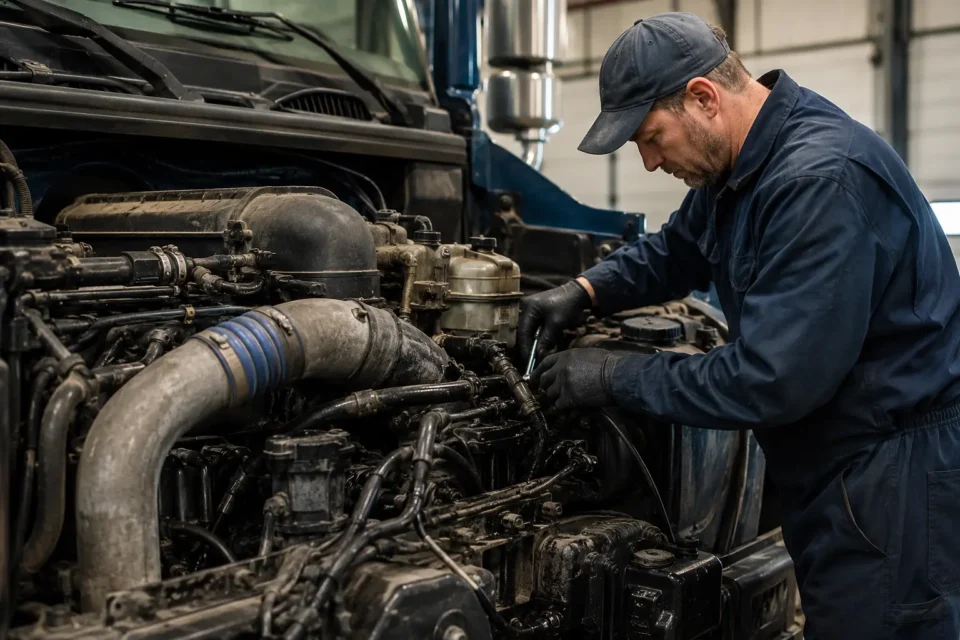
The 200,000-mile mark means something different on a diesel truck than on a gasoline vehicle. Where a high-mileage gasoline engine is often approaching the end of its practical service life, a well-maintained diesel at 200,000 miles is frequently in the middle of its working life — still capable of reaching 400,000, 500,000, or more miles with the right maintenance approach.
The engines are built to different standards: heavier castings, forged internals, lower operating RPM, and compression-ignition combustion that inherently favors longevity over high-revving performance.
But reaching those mileages reliably is not automatic, and it is not achieved by continuing to follow the same maintenance routine that worked between 0 and 100,000 miles. High-mileage diesel maintenance is a different discipline from new-truck maintenance.
The components that have been accumulating wear for 200,000 miles have different vulnerabilities, different failure modes, and different service priorities than the same components at 50,000 miles. Understanding precisely what changes — and adjusting the maintenance approach around those changes — is what separates diesel trucks that reach half a million miles from those that accumulate expensive repair bills in the 200,000 to 300,000 mile range.
The Fuel Injection System: The Highest-Priority High-Mileage Component
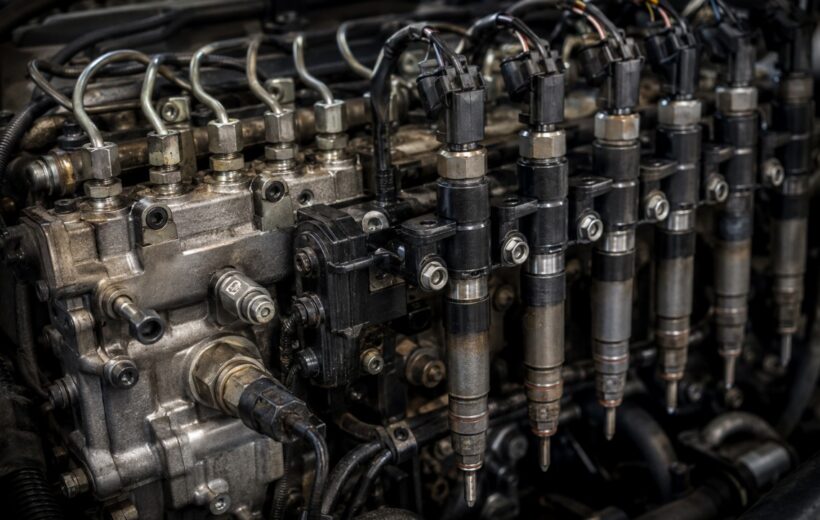
Modern diesel fuel injection systems operate at pressures between 20,000 and 36,000 PSI, with injector nozzle orifices machined to tolerances of single-digit microns. These systems are engineering marvels of precision, and that precision is exactly what makes them the highest-priority maintenance focus as mileage accumulates.
There is no component in a diesel truck where the cumulative effect of 200,000 miles of operating cycles, fuel quality variation, and minor contamination events creates more consequential wear than in the high-pressure injection system.
By 200,000 miles, injector nozzle spray patterns have typically drifted measurably from their factory calibration, even in well-maintained trucks. The nozzle orifices that meter fuel delivery erode imperceptibly with each of the billions of injection events they have processed, and that erosion alters the spray pattern, the injection timing, and the fuel quantity delivered per cycle.
The symptoms are gradual and easy to rationalize: slightly lower fuel economy, a hint more black smoke under load, a barely perceptible roughness at idle. Each symptom individually is easy to dismiss. Together, they describe an injection system operating outside its designed parameters and accelerating combustion-related wear on pistons, rings, and cylinder walls with every hour of operation.
High-pressure fuel pump condition is the companion concern. The cam-and-follower assemblies and plunger-barrel sets that generate injection pressure wear gradually over 200,000 miles of operation, and that wear begins reducing maximum achievable rail pressure before it produces any detectable symptom.
A pump producing 28,000 PSI instead of its designed 36,000 PSI delivers fuel to the injectors at lower pressure than the ECM expects, altering combustion quality in ways that affect power, efficiency, and emissions compliance without generating any fault codes. Pressure testing the fuel rail under load at high mileage is the only way to identify this degradation before it progresses to pump failure.
The practical maintenance response at 200,000 miles: conduct a professional injector flow test and rail pressure evaluation. If injectors are within acceptable flow tolerance, a professional cleaning and recalibration service can restore performance. If nozzle wear has progressed beyond the point where recalibration corrects it, replacement is the appropriate response — and doing it at a planned service interval is substantially less expensive than doing it after a cylinder wash-down event has scored the cylinder walls below the injector tip.
Cooling System: Why It Becomes Critical at High Mileage
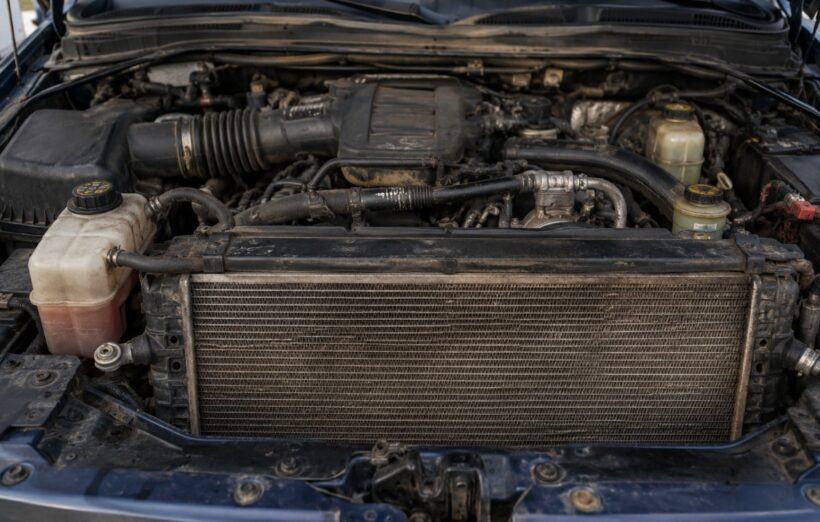
A diesel engine produces more heat per unit of displacement than a gasoline engine, and that heat load accumulates in the cooling system components over 200,000 miles in ways that make cooling system maintenance more critical at high mileage than at any earlier point in the truck’s service life.
Overheating is one of the few failure modes that can destroy a diesel engine rapidly and completely — a sustained overheat event that cracks a cylinder head or warps a head gasket creates repair costs that can exceed the value of the truck.
Coolant chemistry degrades in two distinct ways over high mileage. The supplemental coolant additives (SCAs) that protect cast iron cylinder liners from cavitation erosion — the microscopic pitting caused by combustion pressure waves collapsing vapor bubbles against liner surfaces — deplete over time and distance. A high-mileage diesel running coolant with depleted SCA concentration is accumulating cavitation damage that is invisible until it becomes a liner failure.
The base coolant itself also degrades, becoming more acidic as inhibitor packages break down, and that acidity attacks water pump seals, radiator cores, and cooling system aluminum components from the inside.
Radiator and heater core condition at 200,000 miles reflects the cumulative effect of every heat cycle, every contamination event, and every period where coolant chemistry was less than ideal. Internal deposits reduce the efficiency of heat transfer; external core fin damage from road debris reduces airflow.
A radiator producing 80 percent of its designed cooling capacity is adequate during normal operating conditions and insufficient during sustained towing in summer heat — the conditions that produce the most critical thermal stress on a high-mileage engine.
Water pump mechanical condition deserves direct inspection at high mileage rather than inspection-by-symptom. Impeller erosion, bearing wear, and seal degradation all reduce water pump output below the level required to maintain circulation through the full system under high-heat operating conditions. A water pump that circulates coolant adequately at highway cruise may not circulate it fast enough to prevent localized hotspots during a sustained grade climb with a heavy trailer.
At 200,000 miles, water pump replacement as a preventive measure rather than a reactive repair is cost-effective insurance against the far more expensive consequence of a cooling failure.
Turbocharger: Managing Accumulated Wear and VGT System Degradation
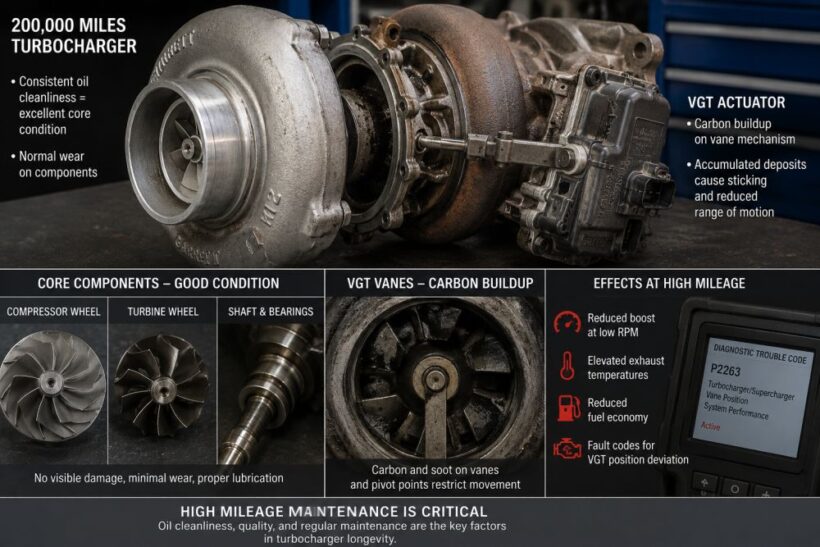
The turbocharger on a modern diesel has processed the same airflow, the same oil, and the same combustion byproducts for 200,000 miles by the time the truck reaches high-mileage territory. The core rotating assembly — compressor wheel, turbine wheel, and shaft supported by journal bearings or ball bearings — can maintain excellent condition across 200,000 miles if oil cleanliness has been consistently maintained.
Turbine and compressor wheel damage from contamination ingestion, however, is cumulative and irreversible, and its effects on boost pressure and efficiency become more pronounced as mileage accumulates.
Variable geometry turbochargers (VGT), which are standard on virtually all modern diesel truck applications, introduce a specific high-mileage failure mode that fixed-geometry turbos do not share: vane mechanism sticking.
The movable vanes that control turbine housing geometry operate in a high-temperature, carbon-rich exhaust environment that gradually deposits carbon and combustion residue on the vane pivot points and actuator mechanism. At low mileage, the actuator motor can overcome this buildup. At high mileage, the accumulated deposit can reach a point where the actuator cannot fully move the vanes through their range, resulting in reduced boost at low RPM, elevated exhaust temperatures, reduced fuel economy, and eventually fault codes for VGT position deviation.
Forced VGT cleaning — using a scan tool commanded VGT exercises and appropriate cleaning procedures — can restore vane movement when sticking is caught early. Neglected VGT sticking eventually progresses to actuator failure or vane seizure that requires turbocharger removal and rebuild or replacement. At 200,000 miles, including a VGT function test in routine service and addressing any hesitation in vane response before it becomes a sticking condition is significantly less expensive than a turbocharger replacement.
Rubber and Seals: The Invisible High-Mileage Failure Risk
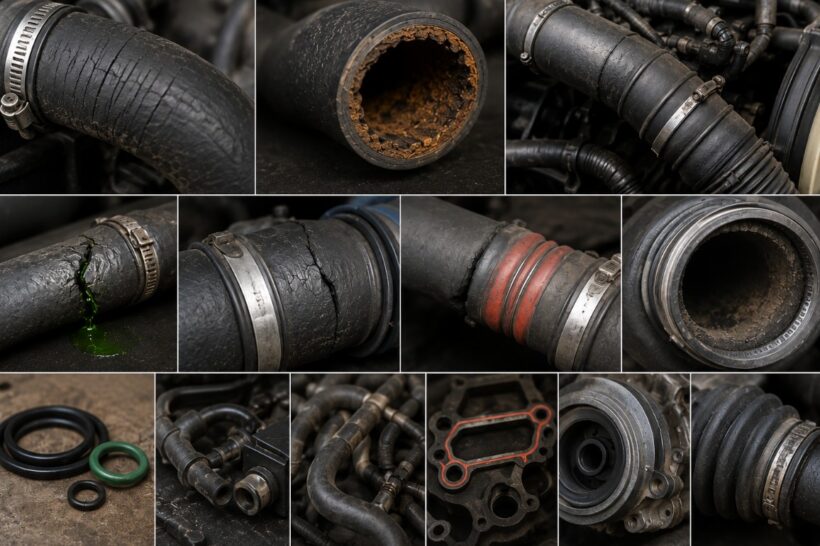
Every rubber component in a diesel truck — every hose, every seal, every boot, every gasket — has been subjected to 200,000 miles of heat cycling, vibration, chemical exposure, and UV degradation.
Rubber degrades gradually and silently, maintaining its structural function while losing elasticity and chemical resistance until the moment a hose splits, a seal weeps, or an intake duct crack allows unfiltered air into the engine. None of these failures announces itself in advance, and each has consequences that range from annoying to catastrophic depending on where it occurs.
Coolant hose condition at high mileage is particularly important. The combination of heat cycling, internal pressure, and the chemical environment of hot coolant degrades hose material from the inside out. External inspection — squeezing hoses to check for softness, cracking, or sponginess — catches surface degradation but may not reveal internal deterioration that leaves the outside of a hose appearing acceptable while its inner lining is breaking down into the coolant stream.
At 200,000 miles, replacing all coolant hoses, regardless of external condition, as a scheduled service rather than waiting for a failure is cost-effective given the labor that would be required to replace a failed hose on the road and the cooling system damage that can result from a hose failure in the wrong conditions.
Intake system rubber — the boots and couplers between the air filter housing, intercooler, and turbocharger inlet and outlet — is the most safety-critical rubber in the truck from an engine longevity perspective. An intake boot crack that admits unfiltered air bypasses every dollar spent on air filtration and delivers abrasive particulates directly to the turbocharger compressor wheel and engine intake.
These cracks are often small, develop slowly, and may only open under boost pressure — making them nearly impossible to find by visual inspection alone. Replacing all intake couplers and boots at 200,000 miles as a scheduled service is standard practice among diesel shops that maintain high-mileage commercial equipment.
Transmission and Drivetrain: The Components That Outlast Their Service
Automatic transmissions in diesel truck applications — particularly the Allison series found across many commercial and pickup platforms — are built with substantial durability margins. They frequently reach 200,000 miles in good condition and are capable of much higher mileage with proper fluid and filter maintenance.
The failure mode at high mileage is typically not catastrophic transmission failure but gradual degradation of the torque converter clutch, the friction packs, and the solenoid bodies that control hydraulic shifting.
Transmission fluid condition at 200,000 miles reflects the accumulated thermal history of the transmission. Every towing event, every high-load grade climb, every sustained hauling cycle has contributed heat to the fluid that accelerated oxidation and degraded the friction modifiers and viscosity index improvers in the transmission fluid.
A transmission fluid sample sent for analysis at high mileage provides a definitive picture of fluid condition and early warning of clutch pack wear through elevated friction material debris in the sample — information that a simple visual inspection cannot provide.
Driveshaft U-joints are another component where 200,000 miles of load cycles, vibration, and grease consumption produce wear that is not always visible externally but measurable as increased driveline vibration or clunk during torque application.
Inspecting every U-joint for play and greasability at high mileage — and replacing any that show perceptible wear — addresses a failure mode that, when it progresses to complete U-joint failure, can cause driveshaft separation and vehicle damage that far exceeds the cost of preventive replacement.
Adjusting Service Intervals for High-Mileage Operation
The factory service intervals that governed the truck’s maintenance through its first 200,000 miles were calibrated for new-component tolerances and designed for a statistical average of operating conditions.
At high mileage, both of those assumptions no longer apply. Components are operating with accumulated wear that makes them more sensitive to oil cleanliness, fuel quality, and cooling system condition than they were when new. Diesel engine maintenance schedule and service intervals for high-mileage equipment consistently recommend tightening key intervals — specifically oil changes, fuel filter service, and coolant testing — rather than extending them, because the margin for error on worn components is smaller than on new ones.
Oil analysis becomes more valuable at high mileage than at any earlier service stage. A worn engine consumes oil differently, accumulates metallic wear debris at different rates, and is more sensitive to extended drain intervals than a new engine running the same oil. Trending wear metal levels across consecutive oil analysis samples over the 200,000-to-300,000-mile range provides an early warning system for developing bearing wear, ring wear, and valve train issues that would otherwise only become apparent when performance symptoms or catastrophic failure occur.
Establishing a high-mileage maintenance baseline — a systematic inspection of every system that has accumulated 200,000 miles of wear, with documented results that inform future service decisions — is the most valuable investment a high-mileage diesel owner can make at this service milestone.
Diesel engine troubleshooting and diagnostic techniques applied proactively at a mileage milestone catch developing problems at the point where they are correctable with targeted maintenance rather than reactive repairs. The trucks that reach 500,000 miles reliably are not the ones that got lucky — they are the ones whose owners treated the 200,000-mile mark as a reason to look harder, not a reason to assume everything is fine.
The Bottom Line
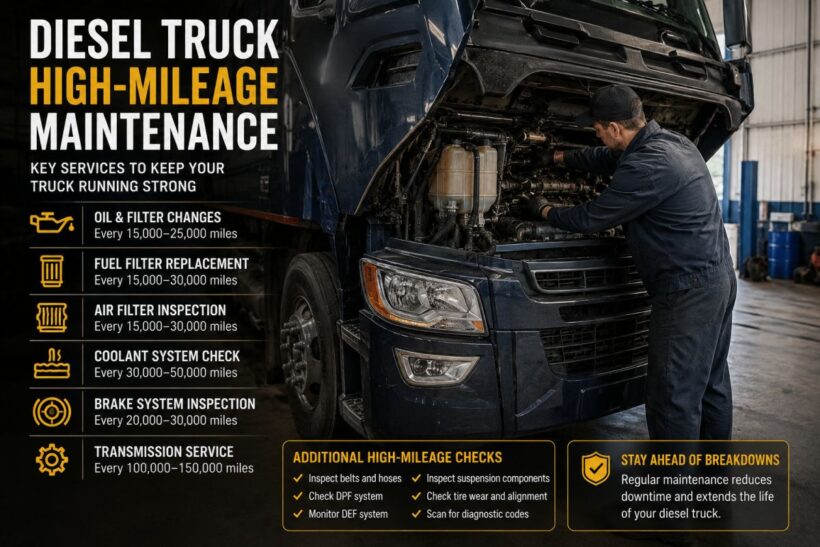
Two hundred thousand miles on a diesel truck is not a warning sign — it is a proof of concept. It demonstrates that the fundamental platform is sound and that the maintenance history has been adequate to reach this point without catastrophic failure.
What changes at 200,000 miles is not the engine’s fundamental capability but the specific maintenance priorities that protect it through the next 200,000 miles.
Fuel injection system evaluation, cooling system component replacement, turbocharger VGT maintenance, rubber and seal renewal, and tightened service intervals on oil and fuel filtration are the adjustments that turn a high-mileage diesel from a truck that is running on the accumulated goodwill of its early maintenance history into one that is actively managed for the wear characteristics it now has.
Done consistently from the 200,000-mile mark forward, these practices are what produce the diesel trucks that become legends — the ones still working reliably at mileages that gasoline engine owners can barely imagine.
